Today, Ukrainians are fighting with the same courage, defending their freedom – and ours. We cannot change geography. Everything else is in our hands. By standing together, Nordic and Baltic hand in hand, we are strong enough to say “no – no more” to those who believe it is possible to turn the clock back.
35 Years of Nordic–Baltic Cooperation
Thirty-five years ago, the Nordic Council of Ministers made a clear political choice: to be present in the newly independent Lithuania from the very beginning. On 1 February 1991, this decision was formally approved, creating the country’s first international representation and sending a powerful signal of solidarity at a critical moment in Lithuania’s history.
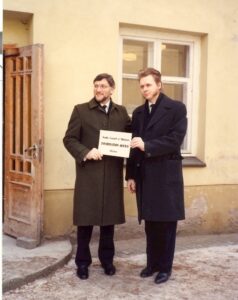
From left: Thor Pedersen, Chairman of the Nordic Council of Ministers, and Valdemaras Katkus, Acting Minister of Foreign Affairs of the Republic of Lithuania, in front of the Nordic Council of Ministers office in Vilnius on 1 February 1991
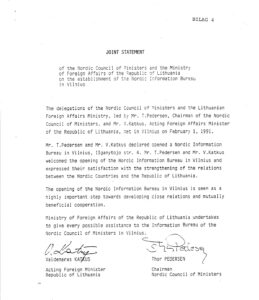
Joint statement on the opening of the Nordic Council of Ministers Office in Lithuania (at the time, the Nordic Information Office), signed on 1 February 1991
It was a decisive choice. The vision was solidarity, development, and political support – institutional partnerships with public authorities and civil society institutions. Not ceremonial, but down-to-earth, practical, and people-to-people oriented. It still is. This is the Nordic way – and a perfect fit for Lithuania.
Over the past 35 years, cooperation has developed through many small steps that have brought us far.
Today, the Nordic Council of Ministers works to integrate government sectors across the region, with its office in Lithuania serving as a vital bridge and facilitator. Building the Nordic–Baltic region is not a future goal – it happens every day. Digitalization is a flagship example, with the Baltic states fully embedded in Nordic initiatives, from cutting-edge quantum research to breakthroughs in artificial intelligence.
Our cooperation also encompasses social affairs and public health, culture and education, civil society and NGOs, energy security, the green transition, and the development of innovative and responsible business.
Beyond our region, we support civil society in Ukraine and empower democratic forces in Belarus. By facing shared challenges and pursuing common solutions, the Nordic–Baltic community moves forward hand in hand. We must be prepared, as we are facing the most serious challenge to our security and way of life since World War II. Together, we are stronger, safer, and more resilient than any of us could be alone.
A Middle Power with a Strategic Vision
Together, the Nordic–Baltic community is a geopolitical factor: a middle power of more than 30 million people, with 8 votes in the UN and NATO and 6 in the EU. We are an economic powerhouse – the world’s 12th-largest economy and the 5th-largest in Europe. We are at the forefront of education and research, leaders in digitalization, and among the top contributors to Ukraine.
But first and foremost, we are something that cannot be measured in numbers or statistics. We are a community of shared identity and values, cultural belonging, and togetherness. Without sounding pompous, we speak of ourselves as a family of countries and people.
This gives us strong footing when facing a revisionist and threatening neighbor. On land, Norway shares a 198 km border with Russia in the north and a maritime delimitation line of about 1,750 km; Finland shares 1,340 km; Estonia 345 km; and Latvia 280 km. Lithuania and Latvia together share an 835 km border with Belarus, and Lithuania has a 415 km border with Kaliningrad, on land and at sea. The protection and control of this continuous 5,000 km external border constitute our outer shield.
The strongest resilience and security, however, are forged within. We are assuming a growing role in strategic cooperation on societal resilience and preparedness. It is like the human body: if you are not strong and healthy, you cannot carry the weight of armor.
This brings me back to the commemoration of Freedom Defenders’ Day in the Seimas. On this day of unity, several speakers addressed issues of disagreement. The message was clear: unity is built through free and open exchange, mutual respect, and democratic principles. This is how trust and cohesion are embedded in society.
Trust is often described as Nordic gold – a political and cultural currency we share with Lithuanians. Cohesion allows us to deal with sensitive issues. We should talk more about diversity, equality, and inclusion. We should not shy away from questions of independent media. We must ask how we build societies where no one feels left behind – and why we still fall short of full gender equality.
Our Nordic visionary goal is to become the most sustainable and integrated region in the world by 2030. I am convinced that by then, this will be a shared Nordic–Baltic reality. I can imagine no other region in the world better positioned to reach such an ambitious goal.
What’s Next?
Where will the next 35 years take us? At Davos, “value-based realism,” inspired by Finnish President Alexander Stubb, was reintroduced as a strategic orientation – meaning that we remain committed to the liberal democratic order and the rule of law, while being pragmatic in our methods and realistic about results. We were reminded that middle powers have both the capacity and the responsibility to stand firm on human rights, sustainable development, solidarity, sovereignty, and territorial integrity.
This orientation is not new to us. In fact, it is what Nordic–Baltic cooperation has embodied for many years. It is people-to-people centered cooperation practiced every day; a form of slow diplomacy that builds momentum over time. We are that middle power.
We made this choice 35 years ago. We make it again today – for the next 35 years.
Ole Andreas Lindeman is a Norwegian diplomat and Director of the Nordic Council of Ministers Office in Lithuania.